You know you own a pair of needle-nose pliers. You just don’t know where they went. So you buy another pair, and a few months later you have three pairs and still can’t find one when you need it.
The fix is not a bigger toolbox. It is a simple system: sort by job, keep a small kit for the common stuff, and let the big box hold the rest. Here is how to set it up in an afternoon.
Sort by job, not by tool type
Most people sort tools the way a store does: all the screwdrivers together, all the pliers together. That works in a store. At home, you rarely need “a screwdriver.” You need to hang a shelf or fix a leaky trap.
Group tools by the job they do together. A few common groups:
- Hanging and mounting: tape measure, pencil, small level, stud finder, screwdrivers, drill bits, wall anchors.
- Plumbing fixes: adjustable wrench, pliers, plumber’s tape, a small bucket, rags.
- Electrical basics: voltage tester, wire strippers, screwdrivers, electrical tape.
- Furniture and assembly: hex keys, a screwdriver with swappable bits, a small hammer, a rubber mallet.
Yes, a tool can live in more than one group. A screwdriver shows up everywhere. That is fine. Buy a second one for the kit rather than hunting through groups every time.
Build a grab-and-go kit
Most small jobs around the house use the same handful of tools. Pull those out and keep them together where you can grab them in one move. This kit is what you reach for ninety percent of the time, so it should be easy to carry and easy to see into.
A solid starting list:
- Screwdriver with a set of bits, or a few basic screwdrivers
- Pliers and needle-nose pliers
- Adjustable wrench
- Tape measure and pencil
- Utility knife
- Small level
- Hex keys
- A few common screws, anchors and bits
Keep the kit to compact, small-to-medium tools. If a tool is too big to carry easily, it belongs in the box.
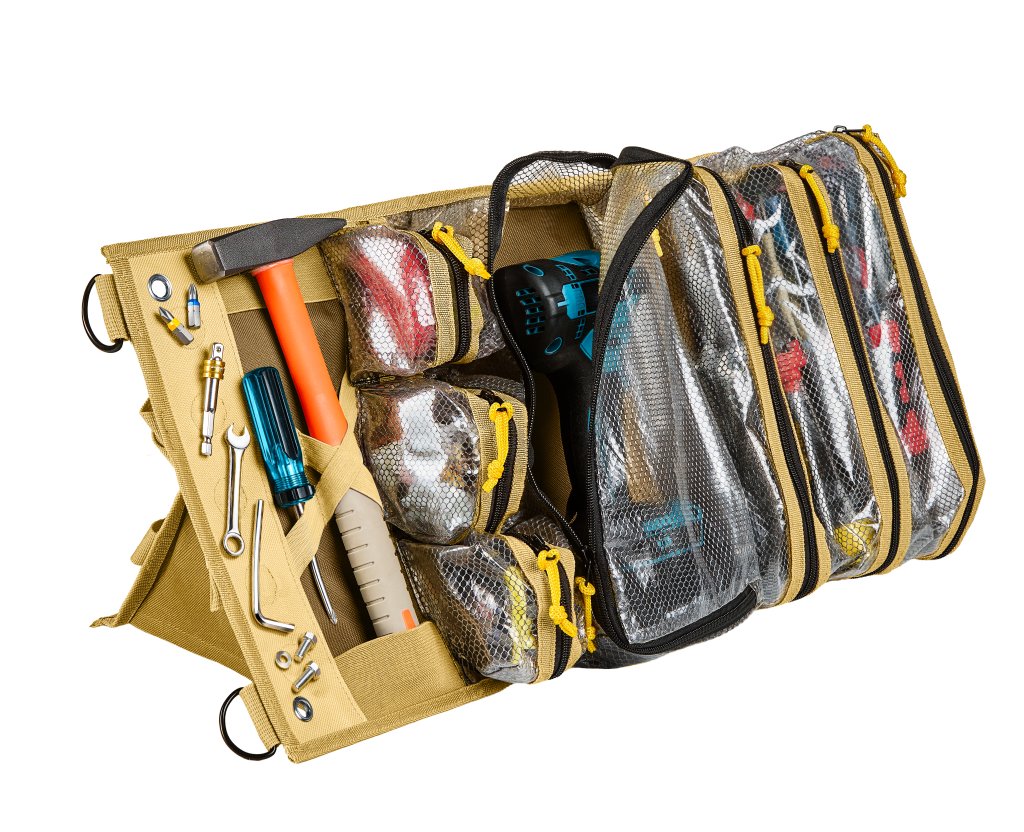
How you carry it matters. A roll-up with clear pockets works well because you can see each tool without digging. The Myolnir tool bag on Amazon is built that way: see-through zippered pockets, plus a magnetic strip for loose screws and bits, and it stands upright so the tools face you. Any organizer with the same idea will do the job, whether it is a roll, a tray or a small bag.
What to leave in the big box
The big toolbox, or the garage shelf, is for everything that does not earn a spot in the kit. A simple rule: if you use it only a few times a year, it stays put.
That usually means:
- Long or heavy tools: hand saws, pry bars, large hammers, big wrenches.
- Specialty tools: pipe cutters, tile tools, the one-off gadget you bought for a single project.
- Bulk supplies: boxes of screws, spare blades, extra tape, sandpaper.
- Backups and duplicates: the second tape measure, the spare pliers.
Organize the box by job too. Use a few small bins or trays inside so the plumbing bits are not buried under the drywall tools. When you start a bigger project, pull the bin you need and carry it over.
Make everything visible and give it a home
A tool you cannot see is a tool you will not find. A few habits fix most of the mess:
- One spot per tool. If a tool has a home, you notice when it is missing.
- Clear or open storage. Clear pockets, open trays and wall-mounted racks beat deep drawers.
- Containers for small parts. Screws, anchors and bits get lost fast. Use small jars, a labeled organizer or a magnetic strip.
- Label the bins. It feels fussy until the day you are in a hurry.
Hanging helps too. A kit with D-rings, like the Myolnir bag, can hang open on a wall, a ladder or a van door, so everything is at eye level while you work. A pegboard or a couple of hooks does the same job in a garage.
Reset after every job
A system only works if you keep it up. Spend five minutes at the end of each job putting every tool back where it lives. Restock what you used up: screws, tape, bits.
Twice a year, do a quick review:
- Anything you reached for in the box more than once? Move it to the kit.
- Anything in the kit you never touched? Move it to the box.
- Broken, rusty or duplicate tools? Fix, wipe down or donate them.
That is the whole system. Sort by job, carry a small kit, leave the rare stuff in the box, and put things back. The next time you need those pliers, you will know exactly where they are.

Leave a comment