Every Saturday project starts with a plan. It is a good plan. It fits in the morning, leaves time for lunch, and has no surprises in it.
Then the project starts. Here are five things we tell ourselves before that point, and what to do instead.
Lie 1: “It’s a ten-minute job”
It might be. Once. In a video, with the right tools already laid out and a wall that has never met a rusted screw.
Real jobs have a hidden second job underneath. The faucet swap turns up a corroded shutoff valve. The shelf install turns up a stud that is not where studs are supposed to be.
The fix: Double your estimate, then add a buffer for the surprise. Before you start, read the whole job through once and write down the steps. If you cannot list the steps, it is not a ten-minute job.
Lie 2: “I know exactly where that wrench is”
You do know. It is in the garage. Or the truck. Or the kitchen drawer you opened last month for something else. Twenty minutes later you are holding a different wrench and a tape measure you forgot you owned.
Hunting for tools is the quietest time-waster of any project. It also kills momentum, and momentum is what gets a job finished before dark.
The fix: Before you touch the project, pull every tool you expect to need and put it in one place. Then check the list against the job steps.
- Pick one spot to work from, and keep everything there.
- Keep tools where you can see them, not buried in a pile.
- Put each tool back in its spot when you finish with it.
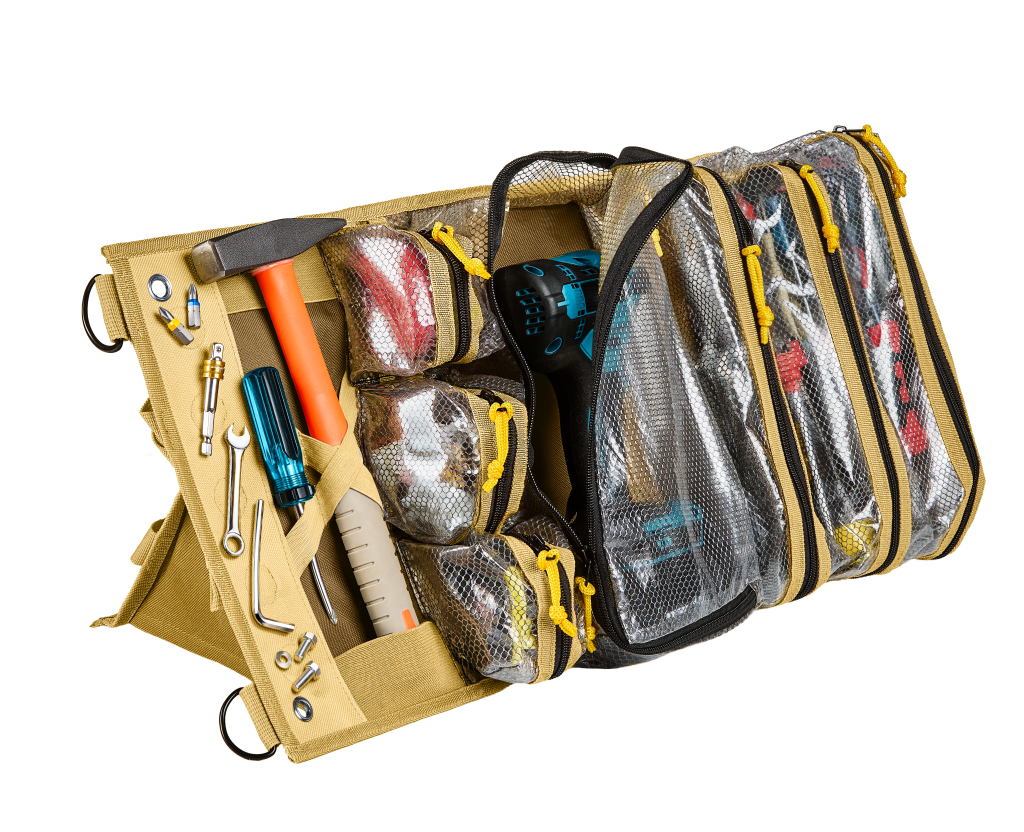
A tool roll helps if you do not have a bench handy. The Myolnir tool bag on Amazon is one example. It has a built-in kickstand, so it stands upright on a tailgate, a bench or the floor with the tools facing you. The pocket fronts are see-through, so you can spot the wrench without opening anything. A magnetic strip holds loose screws and bits.
Lie 3: “I have all the parts”
You have most of the parts. You have the screws, just not the right length. You have the washers, just not the size that fits. The store is twenty minutes away, and it closes earlier on Saturdays than you remember.
The fix: Do the parts check the night before, not the morning of.
- Lay out what the job needs and compare it to what you have.
- Bring the old part to the store so you can match it side by side.
- Buy a few extra of the small stuff, like screws, anchors and washers. They are cheap, and you will drop one.
Lie 4: “I don’t need to shut anything off”
“It’s only one wire.” “It’s only a small leak.” This is the lie with real consequences, and it is the one worth taking seriously even if you ignore the rest.
Water shutoffs can be stuck, mislabeled, or hidden behind boxes. Breaker panels are often labeled with confidence and no accuracy.
The fix: Find and test the shutoff before you start.
- For water, locate the valve and turn it. Then open the faucet to confirm the flow stops.
- For electrical work, switch off the breaker, then confirm the circuit is dead with a non-contact voltage tester. Do not trust the label.
- If you are not sure the power is off, it is not off.
- If the job looks bigger than you expected, call a licensed pro. That is not a defeat. It is the plan working.
Lie 5: “I’ll remember how it goes back together”
You will not. Nobody does. By the third hour you will be holding a small spring and a feeling of mild dread.
The fix: Use your phone as a record.
- Take a photo before you take anything apart.
- Take another at each major step.
- Keep screws and small parts from each stage in a labeled cup, a zip bag or a magnetic tray, so they do not wander.
It takes a few seconds per photo. It saves you from rebuilding the whole thing from guesswork.
The honest version of the plan
A better Saturday plan sounds less exciting and works better. Read the job, gather the tools, check the parts, shut things off, take photos. Then expect one surprise anyway.
You will still say “ten minutes” out loud at some point. That is fine. Just do not schedule anything for the hour after.

Leave a Reply